Showing posts with label Theory of Learning. Show all posts

Sunday, 28 April 2013

Glenn Doman Method

Learn from the stage of YOUNG BABY?!!


The baby Fatih has learned to read the Glenn Doman flashcards since the age of 7 months. See! Fatih can read  a lot of words now!


Glenn Doman
Glenn Doman (GD) Method encourages that young babies should learn from the early years. Besides, it focuses on the right brain training. However, differently from Shichida Method which is classroom-based, GD method is home-based. From this GD method, I get a belief with "Every child can be a baby genius!".

Glenn Doman's books:
1. How To Teach Your Baby To Read (1964)
2. How To Teach Your Baby Math (1979)
3. How To Teach Your Baby To Be Physically Superb (1988)

Doman's daughter Janet and son Douglas's books:
1. How Smart Is Your Baby?: Develop And Nurture Your Newborn's Full Potential (Janet & Glenn, 2006)
2. How To Teach Your Baby To Swim: From Birth To Age Six (Douglas, 2006)


“The more you test him, the slower he will learn and the less he'll want to do. The less you test him, the quicker he will learn and the more he'll want to learn. Knowledge is the most precious gift you can give your child. Give it as generously as you give him food.” 

― Glenn Doman, How To Teach Your Baby Math


You may see other links:
1. Doman Flash Cards (To create your own flashcards by using your creativity is rather than buying!haha)
2. Doman Method

Wednesday, 17 April 2013

Theory of Multiple Intelligence (Howard Gardner)


"Kids go to school and college and get through, but they don't seem to really care about using their minds. School doesn't have the kind of long term positive impact that it should."

-- Howard Gardner


Multiple Intelligence
Howard Gardner has identified seven distinct intelligence. Gardner (1991) purposed that children possess different kinds of minds and therefore learn, remember, perform, and understand in different ways. According to this theory, "we are all able to know the world through language, logical-mathematical analysis, spatial representation, musical thinking, the use of the body to solve problems or to make things, an understanding of other individuals, and an understanding of ourselves. Where individuals differ is in the strength of these intelligence - the so-called profile of intelligence -and in the ways in which such intelligence are invoked and combined to carry out different tasks, solve diverse problems, and progress in various domains."


The learning styles are as follows:


1. Verbal-Linguistic: words and language
2. Visual-Spatial: 3D picture and motion
3. Mathematical-Logical: calculation and thinker
4. Musical-Rhythmic: songs and music
5. Bodily-Kinesthetic: body movement and hands-on activities
6. Interpersonal: an understanding and interaction of others
7. Intrapersonal: an understanding of ourselves
8. Naturalist:the nature


These are the Apps for multiple intelligence!


Source: 
1. multiple intelligence
2. introduction of howard garnder


You may visit to R.E.A.L Kids Kindy which using Multiple Intelligence Approach !!!


Saturday, 23 March 2013

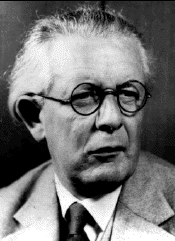
Theory of Constructivism, Jean Piaget


There Are Three Basic Components To Piaget's Constructivism Theory:

1. Schemas 

(building blocks of knowledge)

2. Processes that enable the transition from one stage to another:
(equilibrium, assimilation and accommodation) 

3. Stages of Development
(Sensorimotor, Preoperational, Concrete operational, Formal operational)


Schemas
Schema is the basic building block of unit of knowledge. A schema can be defined as a set of linked mental representations of the world, which we use both to understand and to respond to situations. For example, firstly, a child understand a dog's look is from a picture book. A schema is formed when the child know that a dog has ears, four legs and a tail. 


Assimilation and Accommodation

Jean Piaget viewed intellectual growth as a process of adaptation (adjustment) to the world. This happens through:


Assimilation– Which is using an existing schema to deal with a new object or situation. 


Accommodation– This happens when the existing schema (knowledge) does not work, and needs to be changed to deal with a new object or situation. 


Equilibration– This is the force, which moves development along. Piaget believed that cognitive development did not progress at a steady rate, but rather in leaps and bounds. Equilibrium is occurs when a child's schemas can deal with most new information through assimilation. However, an unpleasant state of disequilibrium occurs when new information cannot be fitted into existing schemas (assimilation).

Equilibration is the force which drives the learning process as we do not like to be frustrated and will seek to restore balance by mastering the new challenge (accommodation). Once the new information is acquired the process of assimilation with the new schema will continue until the next time we need to make an adjustment to it.

For example in assimilation process, the child mentioned above expands his understanding of what a dog looks like by observing it in a park. The dog still has ears, four legs, and a tail. However, the dog has fur and it barks. At this moment, disequilibrium occurs. This is because the dog has fur and barks do not appear in the initial schema. When disequilibrium forms, the initial schema will be added the new information and the child will construct the meaning again. The new schema is formed which is a dog has ears, four legs, a tail, fur and it barks. At this moment, we can say that the child returns the state of equilibrium. 

For example in accommodation process, the child sees a cat with the same traits with the dogs in a park. However, it is a different kind of animals. At this moment, the child reaches the state of disequilibrium again, which is the cat does not bark but it meows. Moreover, parent has to reinforce the child and tell him that this animal is called a cat. Therefore, the child will reconstruct a new schema about the cat which is a cat has ears, four legs, a tail, fur, and it meows. The child returns the state of equilibrium again.


Jean Piaget's Stages of Cognitive Development 


Source : Simplepsychology of Jean Piaget